Magento for B2B vs Magento for B2C: What’s Different, and Can One Store Handle Both?
What is Magento for B2B?
Magento for B2B refers to the platform's capabilities for business purchasing rather than conventional consumer checkout. The buyer on the other end might be a wholesaler, a distributor, a retailer, a dealer, a franchisee, a corporate procurement department or a trade customer buying under an account rather than as an individual.How is a B2B buying journey different?
Business buying tends to look quite different from a retail purchase. Orders are typically larger and repeat on a schedule. Prices are often negotiated rather than fixed. Several people inside the same company may need to buy against one account, sometimes with an approval step before an order goes through. Quotes get requested before a price is agreed. Payment often runs on invoice and company credit rather than a card at checkout, and shipping or payment terms can vary account by account.Key Magento B2B capabilities
- Company accounts, with multiple users operating under one account
- Customer-group and tier pricing
- Private or restricted catalogues
- Request for quote (RFQ)
- Quick order by SKU
- Requisition and saved order lists
- Company credit and custom payment terms
- Account-specific shipping conditions
- Repeat and reorder functionality
What is Magento for B2C?
Magento for B2C is built around the individual consumer journey — discovery, comparison and a fast route to checkout, rather than procurement. The priorities shift towards product discovery, personalisation, promotions, mobile experience, and enough trust signals (reviews, clear delivery information, familiar payment options) to convert a browsing visitor into a one-off or repeat customer.Key Magento B2C capabilities
- Advanced search, layered navigation and filtering
- Promotions and discount rules
- Product recommendations and “frequently bought together”
- Abandoned-cart communication
- Customer reviews and back-in-stock alerts
- Wishlists and product feeds
- Social commerce integrations
- Fast, mobile-first checkout
- Consumer payment methods (cards, wallets, buy-now-pay-later)
Magento for B2B vs Magento for B2C: what's the difference?
The table below sets the two models side by side.| Area | Magento for B2B | Magento for B2C |
| Customer | Companies, dealers, wholesalers | Individual consumers |
| Account structure | Company and multi-user accounts | Individual customer accounts |
| Product access | Public or private catalogues | Primarily public catalogue |
| Pricing | Negotiated / customer-specific | Standard and promotional |
| Order size | Usually larger, bulk | Usually smaller |
| Ordering | SKU lists, bulk and repeat orders | Product discovery and cart |
| Quotations | Frequently important | Usually unnecessary |
| Payment | Invoice, credit, negotiated terms | Cards, wallets, BNPL |
| Checkout | Procurement-oriented | Speed and conversion-oriented |
| Purchase approval | May require a hierarchy | Usually not required |
| Relationship | Long-term account relationship | Individual transactions, loyalty |
| UX priority | Efficiency | Discovery and conversion |
Can one Magento store handle both B2B and B2C?
Yes. A Magento architecture can support both B2B and B2C operations, centralising the commerce resources both channels share while still letting each audience have a genuinely different experience. What can typically be centralised:- Product information
- Inventory
- Orders
- Customer information
- Tax configuration
- Content, integrations and reporting
- Administration
- Prices
- Catalogue visibility
- Promotions
- Account permissions
- Payment and shipping methods
- Checkout workflow
- Content and storefront experience
How does a Magento B2B+B2C hybrid store work?
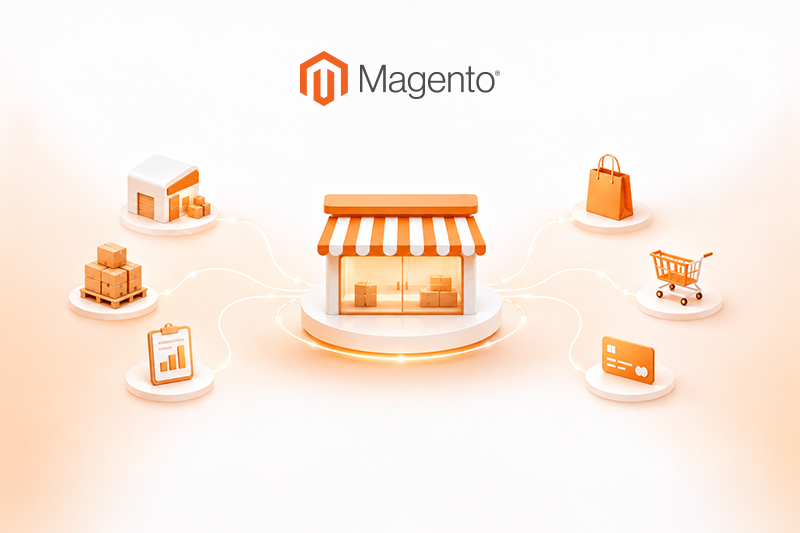
Running one platform doesn't mean every customer sees the same storefront. In practice, a hybrid architecture sits on a central Magento environment holding the shared product catalogue, inventory, orders, customer data, pricing rules and ERP, PIM or CRM integrations, and then presents two distinct experiences on top of it.The B2C experience
- Public storefront
- Consumer pricing and promotions
- Product discovery, reviews and recommendations
- Consumer checkout
The B2B experience
- Secure account login
- Approved customer access and private catalogue
- Contract pricing and bulk ordering
- Request for quote
- Company credit and B2B checkout
Centralised administration doesn't require a one-size-fits-all customer experience.
How can Magento show different prices to B2B and B2C customers?
Differentiated pricing typically runs through customer groups, tier pricing, catalogue pricing rules, account-specific conditions and, where the logic gets more complex, custom development or ERP-synchronised pricing. As a practical example: a product might sell at €120 to a consumer, while an authorised dealer sees €72 on the same SKU after logging in, with further volume discounts kicking in at 25, 50 or 100 units. Once a customer authenticates, Magento can identify their group or account and apply the correct commercial rules automatically, rather than the buyer needing to request a special price.Can B2B customers have a private Magento catalogue?
Yes, and this is one of the more common reasons businesses look at Magento for B2B in the first place. Consider a manufacturer with 1,500 products online: consumers might see 500 retail lines, standard dealers might see 1,000 products, and premium distributors might get the full catalogue, with certain product lines restricted by market or agreement. This pattern underpins dealer portals, distributor stores, wholesale ecommerce and market-specific assortments.B2B accounts need more than a standard customer login
Bolting a “wholesale login” onto a consumer account structure rarely holds up once real B2B volume arrives. Company accounts typically need one master account tied to the business, with several employees able to purchase under it. Roles and permissions then determine who can do what — an administrator, a purchasing manager and a buyer will usually need different levels of access. New trade registrations often need to be reviewed and approved before wholesale pricing or restricted products become visible at all.Magento B2B quick ordering vs B2C product discovery
The two buying journeys pull in different directions. A B2C customer typically searches, browses, compares, reads reviews, adds to cart and checks out. A B2B buyer is more likely to log in, enter a list of SKUs, set quantities across thirty line items and submit the order in one pass. Forcing a B2C-style browsing experience onto that second buyer adds friction they don't want. This is where SKU ordering, saved lists, order history, one-click reordering and bulk quantity entry earn their place in a B2B storefront.Magento Open Source vs Adobe Commerce: what matters for B2B?
This distinction matters more than most generic Magento content admits. Magento Open Source is the free, self-hosted edition and shares the same core codebase as Adobe Commerce, but it does not include Adobe Commerce's native B2B module — company accounts with roles and permissions, shared catalogues, quote-to-order workflows, requisition lists and purchase-order approval chains. Building equivalent functionality on Open Source means extensions, custom modules or ERP-driven workarounds, each carrying its own cost and long-term maintenance.When Magento Open Source may make sense
- No appetite for an Adobe Commerce licence
- Preference for full development flexibility
- Only a subset of B2B functionality is actually needed
- Bespoke, non-standard workflows
- In-house or agency control over architecture and extensions
When Adobe Commerce may make sense
- Complex, multi-entity organisations
- Native B2B requirements out of the box
- Large company-account structures with approval hierarchies
- Sophisticated procurement workflows
- A need for Adobe's enterprise support and SLA
What are the business benefits of combining Magento B2B and B2C?
Centralised commerce management
One operational environment instead of duplicated admin across two platforms.Shared product information
Products are maintained once rather than kept in sync across disconnected systems.Unified inventory
More consistent stock visibility across wholesale and consumer channels.Lower operational complexity
Fewer duplicated processes and integrations to maintain.Consistent brand experience
One brand identity, adapted for two different audiences rather than fragmented across platforms.Easier market expansion
A B2B manufacturer can add a direct-to-consumer channel, or a consumer brand can build out wholesale, without starting from zero.Better commerce data
Broader visibility across customer segments from a single reporting layer.Example: a manufacturer selling to dealers and consumers
Take a furniture manufacturer whose B2B customers are retail stores, interior designers and distributors, and whose B2C customers are homeowners buying directly.The B2B store
- Login required
- Dealer pricing and minimum order quantities
- Bulk ordering and request for quote
- Invoice payment
- Dealer-specific catalogue
The B2C store
- Public prices
- Product inspiration content and reviews
- Promotions
- Consumer payment methods
- Fast checkout
The shared backend
- Products, inventory and orders
- ERP and logistics
- Reporting
When should you use one Magento platform for B2B and B2C?
A hybrid approach tends to make sense when:- You sell to both businesses and consumers
- Both channels share a substantial part of the product catalogue
- Inventory is shared across channels
- Different customer groups need different prices
- B2B customers need private products or catalogues
- Wholesale customers need specialised purchasing workflows
- Centralised administration is a priority
- One ERP needs to serve both sales channels
- You're expanding from wholesale into direct-to-consumer, or the reverse
When might separate commerce architectures make more sense?
A single hybrid platform isn't always the right call. Separate architectures can make more sense when:- The product catalogues are effectively unrelated
- The businesses sit under different legal entities
- Different geographic or regulatory requirements apply
- The ERP environments are already independent
- Operational teams run entirely separately
- Technical requirements diverge significantly
- An acquired business already runs its own infrastructure
What integrations does a Magento B2B+B2C business need?
ERP
Synchronising products, inventory, customer accounts, customer-specific prices, orders, invoices and credit information.PIM
Keeping product information consistent across every channel.CRM
Building one unified view of the customer and the account.Payment systems
Supporting the very different payment requirements consumers and businesses each expect.Logistics and warehouse systems
Coordinating fulfilment across wholesale and retail orders that may draw on the same stock.What should you ask a Magento agency before building a hybrid store?
- Have you implemented both Magento for B2B and Magento for B2C before?
- Should this run on Magento Open Source or Adobe Commerce?
- Which B2B capabilities will be native, extended or custom-built?
- How will customer-specific pricing actually work?
- How will private catalogues be managed?
- Can multiple employees operate under one business account?
- How will Magento integrate with our ERP?
- Will B2B and B2C share inventory?
- How will performance hold up as complexity grows?
- What does the long-term maintenance and upgrade strategy look like?
How much does a Magento B2B+B2C store cost?
There's no honest single figure here. Cost depends on the Magento edition, the number of storefronts, design complexity, which B2B features are needed, custom pricing logic, catalogue permissions, ERP/PIM/CRM integrations, data migration, checkout requirements, hosting and ongoing maintenance. A Magento B2B+B2C project is better estimated around business processes and integrations than around storefront design alone — account structures, pricing rules, catalogue permissions and ERP workflows tend to be what actually drive implementation complexity, far more than the visual design layer.Magento for B2B and B2C: one platform, two customer journeys
Three points worth taking away from all of this:- Magento for B2B and Magento for B2C address genuinely different purchasing behaviours.
- Those two experiences can coexist within a carefully designed Magento architecture.
- The right edition and implementation approach depend on the organisation's B2B processes, integrations, scale and budget — not on a generic recommendation.
Frequency Ask Question
Yes. Magento can be architected to serve business and consumer customers while sharing central commerce resources and maintaining different pricing, catalogues, accounts and purchasing experiences.
Magento for B2B focuses on company purchasing requirements such as account structures, negotiated pricing, bulk ordering, quotes and private catalogues. Magento for B2C focuses more heavily on product discovery, promotions, personalisation and frictionless consumer checkout.
Yes. Pricing can be differentiated through customer groups, tier pricing, catalogue rules and, where necessary, custom or ERP-driven pricing logic.
Yes, depending on the Magento edition and implementation. Catalogue access can be configured or developed around particular companies or customer groups.
It can be. Magento Open Source can be extended for B2B requirements, but businesses should distinguish custom or extension-based B2B functionality from the native B2B capabilities that come with Adobe Commerce.
Not necessarily. They can operate through separate storefront experiences while sharing a common Magento architecture and administration environment.
Yes. Magento can be integrated with ERP systems to exchange products, inventory, customers, prices, orders and other operational data. The exact scope depends on the ERP and the business processes involved.
The decision comes down to B2B complexity, which native capabilities are actually required, customisation needs, scale, integrations, budget and support requirements.