Magento Open Source vs Adobe Commerce: The TCO Decision for SMEs

Magento Open Source vs Adobe Commerce: The TCO Decision for SMEs

If you run a small or mid-sized shop, Magento Open Source with a handful of good extensions will usually cost you less over three years than Adobe Commerce. The licence starts paying for itself in a few situations. You need Adobe’s built-in B2B tools for a lot of trade customers. You’d rather Adobe ran the servers. Or your sales are big enough that the yearly fee looks small next to what a day of downtime would cost.  Something that often gets lost in this debate: both products are built on the same code. In 2026, Magento Open Source and Adobe Commerce both moved to version 2.4.9. They get identical security patches on an identical schedule, and the admin panel looks the same. A developer who writes a module for one can write it for the other without learning anything new.  So the money you spend on Adobe Commerce goes on the extras around that shared core. Think B2B modules, Adobe’s search and product recommendation services, Adobe support and, if you pick a cloud plan, hosting. A feature list won’t tell you whether that’s good value. Your sales model will, along with the size of the business and one practical question: who picks up the phone at 2 a.m. when checkout stops working?  A quick word on prices. Adobe keeps them private, so every licence figure you’ll see below is an estimate from agencies that quote Adobe Commerce all the time. Use them to get a feel for the budget, then ask for your own quote. 

Same code, different package 

Here's what actually separates the two editions in day-to-day use. 
Area  Magento Open Source  Adobe Commerce 
Licence  Free (OSL 3.0)  Annual fee, based on gross merchandise value (GMV) 
Core shop: catalogue, checkout, MSI, GraphQL, Page Builder  Included  Included 
B2B: company accounts, shared catalogues, quotes, requisition lists, purchase orders  Extensions or custom development  Native modules 
Content staging and scheduled campaigns  Not included  Included 
Customer segments, gift cards, reward points, store credit, returns (RMA)  Extensions  Included 
Search  OpenSearch, tuned by you  OpenSearch, plus Adobe's Live Search service 
Security patches  Same schedule, you apply them  Same schedule, you apply them (Adobe-managed on the SaaS edition) 
Support  Your agency or in-house team  Adobe support included 
Hosting  Your choice  Your choice, or Adobe Commerce Cloud 
A quick way to see how much of the Adobe-only feature set you would actually use:  # Which Adobe Commerce B2B modules are enabled on an existing install? bin/magento module:status --enabled | grep -E 'Magento_(Company|SharedCatalog|NegotiableQuote|RequisitionList|PurchaseOrder|QuickOrder)'  If you're already on Adobe Commerce and that list comes back short, you may be paying for features nobody uses. If you're on Open Source and keep buying B2B extensions to fill these gaps, the comparison starts to tilt the other way. 

What three years really cost 

Start with the licence, because it's the line everyone asks about first. Agency planning estimates for the annual Adobe Commerce licence by GMV look like this: 
Annual GMV  Estimated licence per year  Typical setup 
$2–10M  ~$22,000  Self-hosted or Cloud Starter 
$10–25M  ~$40,000  Self-hosted or Adobe cloud 
$25–50M  ~$80,000  Self-hosted or Adobe cloud 
$50M+  $125,000+  Cloud Pro, hosting included 
Source: IWD Agency, updated November 2026. Estimates in US dollars; negotiated quotes can differ by 15–30%.  In practice, the licence is rarely the biggest number in the budget. Over three years, the total depends far more on these: 
  • Build or migration. This is normally the biggest single bill, whichever edition you choose. Adobe Commerce’s native B2B features can cut the build time. On Open Source, you either buy those pieces as extensions or have them built. 
  • Hosting. On Open Source and self-hosted Adobe Commerce, you pick the provider. Adobe Commerce Cloud includes hosting in the price, which saves you a decision but makes the numbers harder to line up side by side. 
  • Extensions. Each one looks cheap on its own. Ten of them don’t. And every extension is more code that has to survive each upgrade. 
  • Patching and upgrades. Adobe sends out the same monthly security fixes for both editions, but somebody still has to test and install them. One agency puts that at $15,000–30,000 a year for a mid-sized shop. 
  • Support. Adobe Commerce comes with Adobe support. On Open Source, support means your agency retainer. 
  • Integrations. Connectors for ERP, PIM, payment and shipping cost about the same either way, since they plug into the same APIs. 
It's easier to compare when you put your own quotes into the same model. A few lines of Python are enough:  # Three-year TCO from your own quotes (one-off + yearly costs) options = {     "Open Source, self-hosted": {         "build": 60_000, "licence": 0, "hosting": 12_000,         "extensions": 6_000, "maintenance": 18_000, "support": 0,     },     "Adobe Commerce, Cloud Starter": {         "build": 85_000, "licence": 22_000, "hosting": 0,         "extensions": 2_000, "maintenance": 18_000, "support": 0,     }, } YEARS = 3 for name, c in options.items():     yearly = sum(v for k, v in c.items() if k != "build")     total = c["build"] + yearly * YEARS     print(f"{name:32} {total:>10,.0f}")  The numbers in that snippet are placeholders. Replace every one with a real quote. The point is to put both options through the same arithmetic, including the costs that don't show up on a licence invoice. 

When is the Adobe Commerce licence worth it? 

Ask yourself one thing: would the licence save you work or risk you’re already paying for? If the answer is yes, it deserves a closer look.  It tends to be worth it when: 
  • B2B drives most of your revenue. Think hundreds of trade customers, each with their own price list, buyers with spending limits, and quotes that bounce back and forth for days. You can rebuild all of that on Open Source. You’ll also be maintaining every line of it yourself. 
  • You’d like fewer suppliers to chase. With Adobe support and Adobe’s cloud hosting, there’s one company to call when something goes wrong. If your IT team is two people, that alone can justify a good chunk of the fee. 
  • Marketing runs a lot of campaigns. Content staging lets the team set up an entire sale in advance, prices, banners and category changes included, and schedule it to switch on at a set time. On Open Source, someone usually ends up doing that by hand at midnight. 
  • Your revenue makes the fee look small. If you turn over $30M a year, a licence of around $80,000 is less than 0.3% of sales. 

It’s harder to justify when: 

  • You sell B2C with simple pricing. Most of what Adobe Commerce adds was built for B2B sellers and big marketing departments. 
  • A good agency already looks after the shop. If your patches, monitoring and support are covered, Adobe support would partly pay for the same thing twice. 
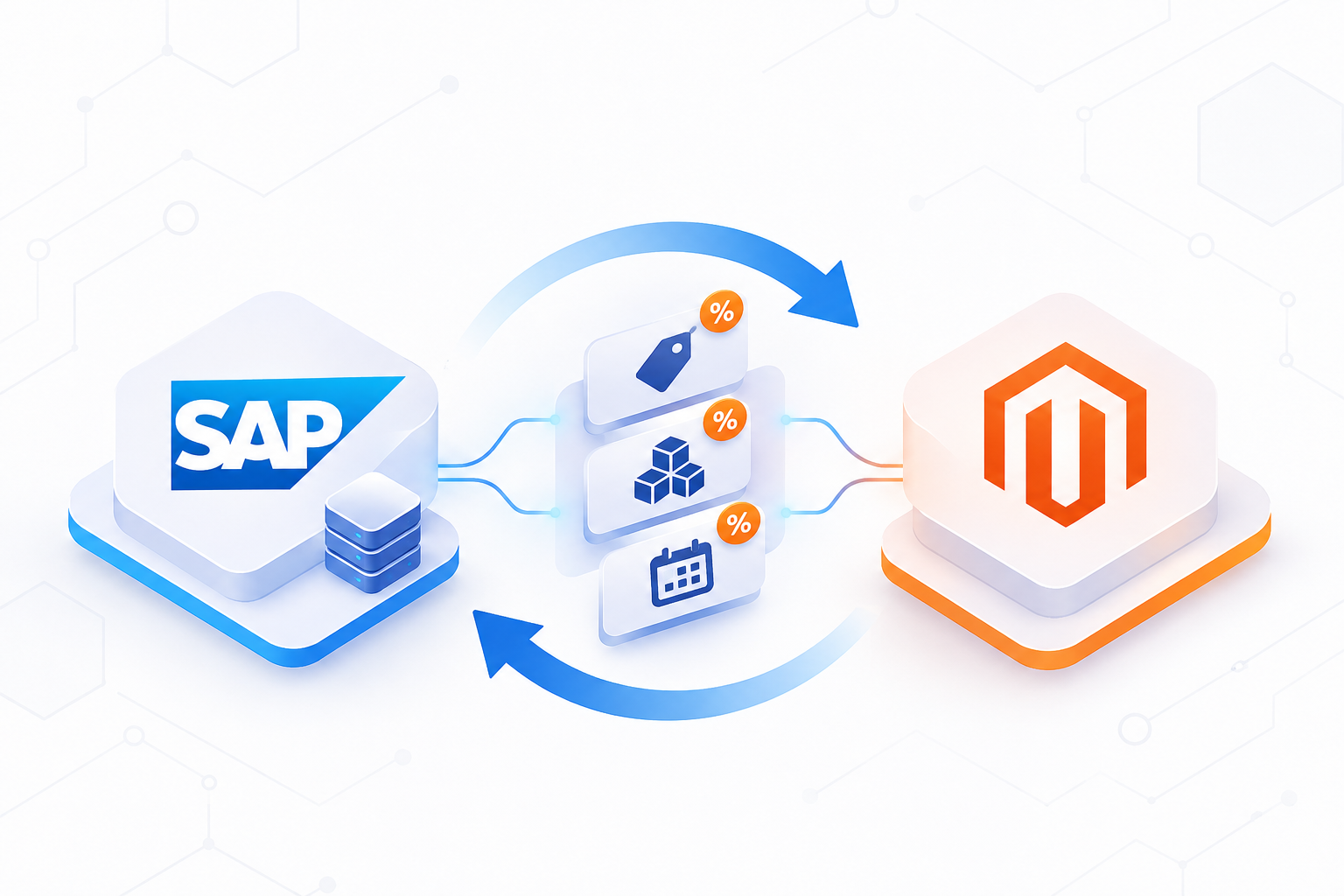
  • Your B2B requirements are fairly basic. Customer-specific prices and a quick-order form can come straight from your ERP connector. On Open Source, for example, SAP Business One price lists and discounts can sync into Magento customer groups. 
  • Your annual sales are below roughly $5M. At that size the licence turns into one of your largest running costs, and you may not use many of the features it pays for. 
A note for shops in Germany: the legal to-do list is identical on both editions. E-invoicing in 2027 and BFSG accessibility still need doing, whichever licence you hold. 

And Adobe Commerce as a Cloud Service? 

There’s a third route these days. Adobe Commerce as a Cloud Service is the SaaS version, first announced at Adobe Summit 2025. Adobe hosts and runs the application, takes care of patches and pushes out updates often. In autumn 2026 there were several releases a month.  Building on it works differently. Classic PHP modules don’t go into the core anymore. Your customisations sit outside it, connected through App Builder, API Mesh and webhooks, and the storefront can run on Adobe’s Edge Delivery Services.  The upside is easy to see. No more upgrade projects, and no monthly patch routine for your team. The downside is less visible. With releases this frequent, an API can change under your feet. Adobe’s November 2026 release notes, for instance, mention that REST orders for physical products now fail without a shipping address. Every integration you run, your ERP connector included, has to keep pace.  Who it suits: bigger teams starting from scratch, with money set aside for API-first development and no wish to run another upgrade project ever again.  Who it doesn’t: shops carrying years of custom PHP modules, and small teams who’d rather have a stable codebase they understand than one that changes every few weeks. For most SMEs in 2026, Open Source or classic Adobe Commerce is still the more sensible pick.

Still weighing it up? 

Ingold Solutions is an Adobe Solution Partner and SAP Silver Partner, and we build shops on both editions, so we’re happy to recommend whichever one suits you. Tell us how you sell, what your B2B customers need and how SAP Business One is set up, and we’ll run both options through the same three-year cost model.  [Book a free edition review]  

Frequency Ask Question

Under the hood they’re the same software. Adobe Commerce adds native B2B modules, content staging, customer segments, Adobe’s search and recommendation services, Adobe support and the option of Adobe-hosted cloud. You pay for those with a yearly licence. 

Adobe doesn’t list prices publicly. Agencies estimate roughly $22,000 a year for shops selling $2–10M annually, rising past $125,000 a year once sales go above $50M. 

In many cases, yes. Your ERP can supply customer-specific prices, and extensions handle quick order and quotes. It gets harder when you need company accounts with buyer roles, approval steps and negotiable quotes for lots of customers. That’s where Adobe’s built-in B2B modules save serious development time. 

Yes, on the same dates. With Open Source and classic Adobe Commerce, though, installing them is up to you or your agency. 

Yes. They share a codebase, so moving up means swapping packages and adding a licence rather than rebuilding the shop. Plan some testing for extensions that do the same job as Adobe’s own features. 
Latest Post

Gepostet auf Google Google
Inka Möller profile picture
Inka Möller
Google star 1Google star 2Google star 3Google star 4Google star 5Trustindex überprüft, ob die Originalquelle der Bewertung Google ist.
Hat alles super geklappt und ganz unkompliziert.
Gepostet auf Google Google
Rene Emser profile picture
Rene Emser
Google star 1Google star 2Google star 3Google star 4Google star 5Trustindex überprüft, ob die Originalquelle der Bewertung Google ist.
Wir bei Hochzeitsrausch Brautmoden sind sehr zufrieden mit der Zusammenarbeit mit Ingold Solutions. Besonders hervorzuheben sind die schnelle Reaktionszeit und der freundliche Service. Ingold Solutions hat unsere WordPress- und Shopify-Seiten überarbeitet und wichtige Funktionen hinzugefügt, wie zum Beispiel eine Terminbuchungsfunktion. Auch die Migration unserer Geschäftsdaten in die Microsoft 365 Cloud verlief reibungslos und hat unsere Arbeitsabläufe spürbar verbessert. Durch die Integration von SAP Business One sind unsere Online- und Offline-Systeme jetzt optimal aufeinander abgestimmt. Wir können Ingold Solutions für ihre technische Expertise und maßgeschneiderten Lösungen uneingeschränkt empfehlen.
Gepostet auf Google Google
Uwe L profile picture
Uwe L
Google star 1Google star 2Google star 3Google star 4Google star 5Trustindex überprüft, ob die Originalquelle der Bewertung Google ist.
Die Kooperation mit der Ingold Solutions GmbH als unserem Lösungspartner für SAP Business One war für die MIP Consult GmbH eine äußerst positive Erfahrung. Ingold hat uns mit einem maßgeschneiderten Paket beliefert, das ihre umfassende Kenntnis unserer Anforderungen widerspiegelt. Ihr Team hat die SAP-Datenbank effizient konfiguriert, umfangreiche Schulungen angeboten und die Stammdaten sorgfältig hochgeladen, was einen reibungslosen Übergang ermöglichte. Die Implementierung des Multi-Banking-Systems zeugt weiter von ihrer fachlichen Kompetenz und ihrem Engagement für ganzheitliche Lösungen. Die Professionalität und Einsatzbereitschaft von Ingold haben unseren Übergang äußerst effizient gestaltet, und ihre kontinuierliche Unterstützung ist von unschätzbarem Wert. Wir können Ingold Solutions GmbH wärmstens empfehlen für Unternehmen, die erstklassige SAP-Lösungen und exzellenten Service.
Gepostet auf Google Google
Dawid Telesinski profile picture
Dawid Telesinski
Google star 1Google star 2Google star 3Google star 4Google star 5Trustindex überprüft, ob die Originalquelle der Bewertung Google ist.
Ingold Solutions GmbH hat für Numiartis eine effiziente Lösung entwickelt, die als B2B-E-Commerce-Portal und Online-Katalog dient und B2C-Bestellungen vereinfacht. Das verbesserte Design ermöglicht eine reibungslose Navigation und effiziente Kundenregistrierung, was zur Kundengewinnung beiträgt. Dank der Magento Open Source Plattform ist auch die Produkt-Navigation optimiert worden. Wir sind sehr zufrieden mit dem bedeutenden Beitrag von Ingold Solutions zur digitalen Erweiterung unseres Unternehmens.
Gepostet auf Google Google
Attila Totos profile picture
Attila Totos
Google star 1Google star 2Google star 3Google star 4Google star 5Trustindex überprüft, ob die Originalquelle der Bewertung Google ist.
Ingold Solutions proved to be an invaluable partner for Pyronova IS Deutschland GmbH during our recent implementation. Their team seamlessly configured our accounting system, and their expertise was evident as they provided a dedicated German accounting expert, ensuring precise setup tailored to our needs. Furthermore, Ingold's commitment to customization shone through as they worked on seamless and precise configuration of our accounting system within SAP Business One. This addon will undoubtedly elevate our financial operations. Their professionalism, expertise, and dedication to our project's success were exemplary. We highly recommend Ingold Solutions for their exceptional service and comprehensive support throughout our implementation process. Attila Totos Head of Finance Dep. Pyronova
Gepostet auf Google Google
Thomas Schneider profile picture
Thomas Schneider
Google star 1Google star 2Google star 3Google star 4Google star 5Trustindex überprüft, ob die Originalquelle der Bewertung Google ist.
Von Anfang an beeindruckte uns Ingold Solutions mit ihrer Umsetzung von SAP Business One. Sie erfüllten effizient unseren Bedarf an Benutzerlizenzen und integrierten diese in die robuste Infrastruktur von Cloudiax's Private Cloud. Unsere Entscheidung für das Standardpaket wurde dank Ingold Solutions' Geschäftsblueprint-Vorlage präzise umgesetzt, was zu einer perfekten Datenbankkonfiguration führte und unsere Betriebsstruktur optimierte. Ingold Solutions bot mit ihrer Expertise wertvolle Unterstützung. Ihr technisches Team sorgte nicht nur für die richtigen Änderungen, sondern integrierte sie auch nahtlos in die Cloudiax-Umgebung. Die von Ingold Solutions eingesetzten Technologien - von der Private Cloud in Cloudiax über SAP B1 mit HANA bis zum SAP Business One Standard Package - zeugen von einem durchdachten Ansatz, der auf betrieblichen Erfolg ausgerichtet ist. Absolut professionell, nur zu empfehlen! winwall GmbH
Gepostet auf Google Google
Markus Beck profile picture
Markus Beck
Google star 1Google star 2Google star 3Google star 4Google star 5Trustindex überprüft, ob die Originalquelle der Bewertung Google ist.
Schnelle und kompetente Umsetzung zu fairen Preisen mit fähigen Mitarbeitern. Danke
Verifiziert von: Trustindex
Trustindex hat bestätigt, dass diese Bewertungen im Google Unternehmensprofil von Ingold Solutions GmbH veröffentlicht wurden. Mehr erfahren