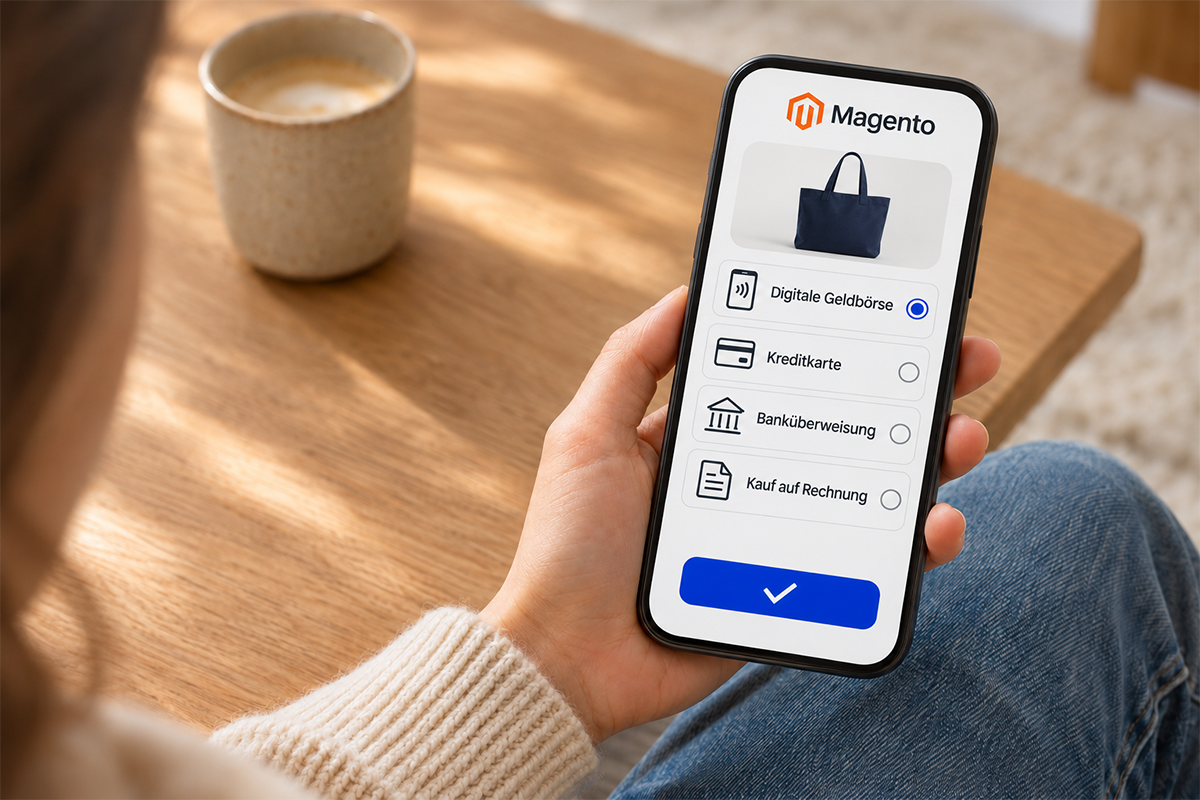
Payment Methods in German Magento Shops: What Customers Expect in 2027
Two out of three German online shoppers have already walked away from a purchase because their preferred way to pay wasn't there. That figure comes from a survey published by PayPal, and it's worth reading twice. According to the same survey, 43% of those shoppers then bought the same or a similar product somewhere else. Only 15% came back and picked another payment method.
So the payment step decides whether the order happens at all. And German shoppers have clear habits here. Many still prefer to pay after the parcel arrives, direct debit is part of everyday life, and more and more people pay with their phone.
This guide looks at what German customers actually use, what changes in 2027, and what B2B shops need on top. It ends with a short checklist you can take to your Magento agency or development team.
Key points at a glance
- PayPal and invoice payment together account for more than half of German online revenue.
- Wero, the banks’ own payment method, is growing fast – ask your provider about it now.
- B2B shops need invoice payment with credit checks and payment terms taken from the ERP.
- Every new payment method adds accounting work, so plan automatic matching in SAP Business One.
How German shoppers pay online
The EHI Retail Institute publishes the most reliable figures every year. Its study "Online-Payment 2026" is based on sales data from 172 German online retailers. Here's how the share of online revenue has moved over the last four years:
Share of German online revenue by payment method
| Payment method | 2022 | 2023 | 2024 | 2025 |
|---|---|---|---|---|
| PayPal | 29.6% | 27.7% | 28.5% | 28.7% |
| Invoice (Kauf auf Rechnung) | 23.8% | 26.7% | 25.8% | 26.1% |
| Direct debit (Lastschrift) | 20.9% | 16.7% | 17.3% | 14.4% |
| Credit and debit cards | 12.1% | 11.4% | 12.3% | 13.7% |
| Instalments (Ratenkauf) | 2.0% | 3.9% | 4.3% | 4.7% |
| Prepayment (Vorkasse) | 3.1% | 4.8% | 4.3% | 3.5% |
Source: EHI "Online-Payment 2026", via IT Finanzmagazin, published May 2026
A few things stand out:
- PayPal and invoice together cover more than half of all online revenue. If your shop is missing either one, you're asking a large part of your customers to change their habits.
- Direct debit is losing ground, down almost three points in a single year.
- Cards are growing, mainly because Visa and Mastercard debit cards have become standard with German bank accounts.
- Apple Pay appears in the figures for the first time, with 1.3% of revenue. Small, but it's only just started.
The EHI's separate report on the top 1,000 German online shops shows how standard wallets have become: 97.2% of those shops now offer at least one wallet, such as PayPal, Apple Pay or Google Pay.
What's new for 2027: Wero
Wero is the payment method built by the European Payments Initiative (EPI), a group of large European banks. It lets people pay straight from their bank account using their banking app. Wero has been live for online shopping in Germany since November 2025, starting with the Sparkassen and Volksbanken.
It's growing quickly. According to DMEXCO, Wero had around 3 million users in Germany in January 2026 and 7.2 million by May, with 12 million expected by the end of the year. Well-known shops have started to accept it, including dm, BAUR, Quelle and CTS Eventim, with IKEA Germany and Lidl's online shop announced as next.
Should your Magento shop offer Wero in 2027? It won't replace PayPal overnight. But it's worth asking your payment provider now whether and when they support it. For shops whose customers are loyal Sparkasse or Volksbank users, it could become a strong option quite fast.
B2B buyers pay differently
A buyer ordering spare parts for her company won't pull out a credit card for a €6,000 order. She expects to pay on account, with the terms her company agreed with yours, and she wants the invoice in the format her accounts team needs.
That makes invoice payment the backbone of almost every B2B shop. The risk is obvious, though: you ship first and get paid later. Three things keep that risk under control:
- Check credit before checkout, not after. A credit check when a new business customer registers, and again when an order goes over a set amount, stops bad debts before they start. Ingold's Creditsafe add-on for SAP Business One brings these checks straight into the ERP.
- Use the payment terms from your ERP. If a customer has 30 days net in SAP Business One, the shop should show and apply exactly that. No second set of rules in the shop.
- Respect credit limits. When a customer has reached their limit, the shop can offer prepayment or card payment for that order instead of simply blocking it.
For new or smaller business customers you don't want to carry the risk for, B2B buy-now-pay-later providers such as Billie or Mondu can take it on. The buyer still gets payment terms, and you get your money straight away, minus a fee.
One more point for 2027: from 1 January 2027, German companies with more than €800,000 turnover in the previous year must issue domestic B2B invoices as e-invoices, and from 2028 that applies to almost all businesses. Your payment set-up and your invoicing have to work together, so plan both at the same time.
The part nobody talks about: matching payments in your ERP
Every new payment method adds work in accounting. PayPal pays out in batches and takes its fee off the top. Card providers settle several days later. Invoice customers pay by bank transfer and often forget the order number. Someone then has to match each incoming payment to the right order in SAP Business One.
With a dozen orders a day, that's annoying. With a few hundred, it's a full-time job.
This is where the shop and the ERP have to work as one:
- The order number and payment method from Magento should travel with the order into SAP Business One.
- Bank statements and payment provider reports should be read in automatically, not typed in by hand.
- Fees should be booked separately, so the open amount on each invoice is correct.
Ingold's multibanking add-on for SAP Business One pulls bank transactions into the ERP and helps match them to open items. Before you add three new payment methods to the checkout, it's worth asking your accounts team how they'll handle the extra bookings.
The legal basics, in plain words
This isn't legal advice, but these four points come up in almost every German checkout review:
- Show your payment methods early. German law (§ 312j BGB) requires shops selling to consumers to say which payment methods they accept at the latest when the ordering process begins. A short line with payment logos on product pages and in the cart does the job, and it also helps sales.
- No extra fees for the common methods. Under § 270a BGB, you can't charge consumers a fee for paying by SEPA bank transfer, SEPA direct debit or a standard card.
- Strong customer authentication. Under PSD2, most card and online payments need a second step, such as confirming in a banking app. Your payment provider handles this, but test it on mobile, where most checkouts drop.
- New rules for instalments and pay-later. The EU's revised Consumer Credit Directive applies from 20 November 2026 and brings many buy-now-pay-later offers under consumer credit rules. Ask your provider how they've adapted, and make sure the information they require shows up in your checkout.
A five-point checklist for your checkout
Take this to your Magento agency or your own developers:
- The basics are all there: PayPal, invoice, direct debit, cards, and Apple Pay or Google Pay.
- Payment methods are visible before the checkout, on product pages and in the cart.
- B2B customers get invoice payment with credit checks and the payment terms from your ERP.
- Accounting is ready: payments are matched automatically in SAP Business One or your ERP.
- You have a plan for Wero and know when your payment provider will support it.
If you're preparing for Black Friday or the Christmas rush, don't change payment methods in the busiest weeks. Test new methods in a quiet month, then roll them out.
Frequently asked questions
Which payment methods do German online shoppers use most?+
PayPal and invoice payment. According to the EHI study "Online-Payment 2026", PayPal accounted for 28.7% of online revenue in 2025 and invoice payment for 26.1%, followed by direct debit (14.4%) and cards (13.7%).
Is invoice payment still important in Germany?+
Yes. It's the second most used payment method in German e-commerce, and in B2B it's the standard. Combine it with credit checks so the risk stays manageable.
What is Wero, and should my Magento shop offer it?+
Wero is a European payment method that lets customers pay directly from their bank account through their banking app. It has been live for online shopping in Germany since November 2025. It's worth planning for in 2027, especially if many of your customers bank with a Sparkasse or Volksbank.
Can I charge a fee for certain payment methods?+
Not for SEPA bank transfers, SEPA direct debit or standard card payments to consumers. German law (§ 270a BGB) rules that out.
How do B2B customers usually pay in a Magento shop?+
On account, with the payment terms agreed in the ERP. Credit checks at registration and credit limits per customer keep the risk under control.
Want a second opinion on your checkout?
Ingold Solutions is a Magento agency and SAP Business One partner. We look at your checkout and your payment set-up together with the accounting side behind it, from credit checks to matching payments in SAP. If your shop is missing a payment method your customers expect, or your accounts team is drowning in manual bookings, we'll show you where to start.