Magento & SAP Business One in the Age of AI Agents: Is Your Ecommerce Data Agent-Ready?
What is agentic commerce?
Agentic commerce describes a shift already visible across enterprise ecommerce discussion in 2026: the buying journey starting inside an AI assistant such as ChatGPT, Claude, Gemini or Perplexity rather than on a retailer's own site. Instead of a shopper clicking through categories, an agent researches, compares and, increasingly, completes purchases on the customer's behalf, using whatever live data a merchant chooses to expose to it. Two emerging open standards sit underneath this shift: the Universal Commerce Protocol (UCP) and the Agentic Commerce Protocol (ACP). Together they aim to let agents do more than recommend a product — they let an agent place an order, track its status and initiate a return, across marketplaces, advertising channels and AI assistants, without a merchant building a separate integration for every AI platform that wants to transact with them.Why AI shopping changes ERP integration
A human shopper who lands on a product page with an out-of-date stock count usually has some tolerance for the gap — they add the item to a cart, and if it turns out to be unavailable, a confirmation email or a phone call resolves it. An AI agent doesn't extend that same patience, and neither does the customer relying on it. The agent states a figure as fact, acts on it, and moves on. If that figure was wrong, the error surfaces as a broken promise rather than a minor inconvenience, and it can happen at a scale no single storefront visit ever could, with the same stale data served to every shopper an agent talks to in the same few minutes. That raises the stakes specifically on the fields that most Magento merchants don't actually store natively: customer-tier pricing, true available-to-promise stock, credit exposure and delivery lead times. For merchants running SAP Business One as the system of record behind Magento, this is precisely the data an AI agent will ask for — and precisely the data that a batch-based, overnight sync was never built to keep current to the minute.Adobe Commerce MCP explained
At its Summit event in April 2026, Adobe introduced the Commerce MCP server, built on Anthropic's Model Context Protocol (MCP) — an open standard that lets AI agents connect securely to a merchant's live data rather than relying on stale scraped content or manually maintained product feeds. The Commerce MCP server exposes core Adobe Commerce functionality — catalogue, cart, pricing, inventory, promotions, checkout, order management and post-purchase flows — to any MCP-compatible agent, so a merchant can build a branded shopping assistant, a voice agent or an upsell bot, or simply allow third-party agents to query their store directly. Adobe has also committed to supporting UCP and ACP so that demand captured through AI assistants, marketplaces and advertising channels can be served through the same infrastructure. For a merchant on plain Adobe Commerce with no external ERP, this is largely a solved problem — the data the agent needs already lives inside Magento. For a merchant running Magento alongside SAP Business One, MCP is best understood as the doorway. What sits behind that doorway — the actual pricing logic, the actual stock position, the actual credit status of the account — is a separate question, and it's the one most commentary on agentic commerce has skipped over entirely.The hidden problem: ecommerce AI is only as accurate as its backend data
Commerce MCP can only expose what already sits inside Magento. For a merchant whose SAP Business One instance governs customer-specific pricing tiers, multi-warehouse stock, credit limits or negotiated delivery terms, none of that is native Magento data — it has to arrive through an integration. Most Magento SAP Business One integrations were built for a world of human shoppers and nightly or hourly batch jobs, where a few hours of lag between systems was invisible to a customer browsing a category page. That lag stops being invisible the moment an AI agent is quoting a customer's credit limit or confirming same-day stock on their behalf. An agent has no way to know that the figure it just read is six hours old, and it has no instinct to hedge the way a salesperson would (“let me just double-check that stock number for you”). It simply reports the number as current. This is the piece of the agentic commerce conversation that very few Magento or SAP partners are addressing publicly, and it is precisely where a properly architected Magento SAP Business One integration becomes a competitive differentiator rather than a back-office convenience.Which SAP Business One data may matter to an AI shopping agent?
Not every field in SAP Business One needs to reach an AI agent, but a working list of the ones most likely to shape what an agent tells a customer includes:- Inventory — true available-to-promise stock across warehouses, not just a Magento-side count
- Customer-specific pricing — contract or tiered pricing tied to a specific business partner record
- Product availability — lead times for made-to-order or backordered lines
- Quantity discounts — volume price breaks that only apply above certain order thresholds
- Delivery information — realistic shipping windows based on warehouse, carrier and order cut-off times
- Account information — which price list, terms or catalogue restrictions apply to a given account
- Credit limits — whether an order would push an account over its approved exposure
Example journey: AI assistant → Magento → SAP Business One
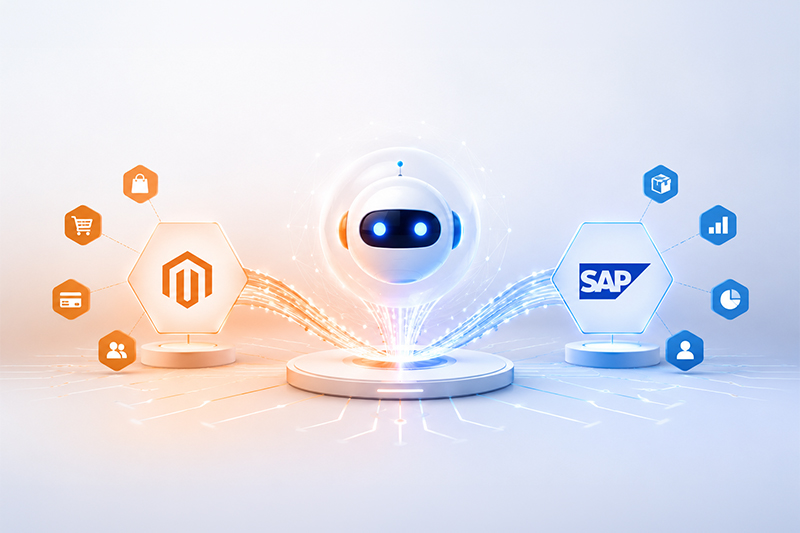
Picture a wholesale buyer asking an AI assistant to reorder a standard line item. The assistant, connected through Commerce MCP, queries the merchant's Magento instance for price, stock and delivery date. If Magento is only holding a cached, previous-sync version of that data, the answer it hands back to the agent is a Magento number, not a SAP Business One number — close, but not necessarily current. In a properly integrated setup, Magento's request instead triggers a near-real-time check against SAP Business One: the buyer's actual price list, their live credit position and true stock across the relevant warehouse. Magento returns that answer to the agent, the agent relays it to the customer, and the order that eventually lands in SAP Business One matches exactly what the customer was told seconds earlier. The difference between these two journeys is invisible to the customer until the moment it isn't — when a confirmed order can't actually be fulfilled at the price or date the agent promised.Why stale ERP data can produce bad AI recommendations
AI agents don't handle missing or ambiguous data the way a person does. Where a human sales rep might pause and check, an agent tends to fill gaps with the most plausible answer available to it, which can mean quoting a list price instead of a contract price, confirming stock that sold out an hour earlier, or recommending an order size that would breach a customer's credit limit. None of this is a flaw unique to any one AI platform — it's a direct consequence of handing an agent a data source that wasn't built to be current to the second. The commercial risk compounds with scale. A single mispriced product page might cost one sale and one apology. A stale field feeding an AI agent can hand out the same wrong answer to every customer who asks that question in the same window, and because the agent states it with total confidence, the customer has no obvious reason to doubt it until the order fails to match what they were promised.How a single source of truth helps agentic commerce
The underlying fix is architectural, not cosmetic: SAP Business One remains the system of record for pricing, stock, credit and account data, and Magento is kept close enough to real time that whatever an MCP-connected agent reads from the storefront reflects what SAP Business One actually holds at that moment. That can mean event-driven updates for the fields that change constantly — stock and credit exposure — alongside more traditional sync patterns for data that moves less often, such as product content and catalogue structure. This is the layer Ingold Solutions has spent years building for clients running Magento against SAP Business One: an integration architecture where the ERP stays authoritative and the storefront stays trustworthy, whether the party reading that storefront data is a person or, increasingly, an AI agent acting for one. As a Berlin-based agency holding both SAP Silver Partner and Microsoft Solutions Partner status, with dual delivery capability across Germany and India, this is exactly the intersection — commerce platform plus ERP plus now AI access layer — that the agentic commerce conversation has largely left unaddressed.Security and permissions for AI-to-ERP workflows
Opening SAP Business One data to an AI agent, even indirectly through Magento and Commerce MCP, raises the same question any new integration surface does: who, or what, is allowed to see which fields. A shopping assistant answering a stock question doesn't need visibility into a customer's full credit history, and a voice agent handling a reorder shouldn't have the same access as an internal reporting tool. A sound approach scopes access tightly — an agent-facing layer that can read the specific fields needed to answer a shopper's question (price, stock, delivery date) without exposing the underlying account, financial or operational detail in SAP Business One that has no business reaching an AI assistant. Every request through that layer should be authenticated, logged and auditable, so that if an agent's answer is ever questioned, there's a clear record of exactly what data it was given and when. This matters more, not less, as merchants move from occasional AI experimentation to production agentic commerce, where third-party assistants outside a merchant's direct control may be querying store data on a customer's behalf.How businesses can prepare today
Merchants don't need to have an AI agent strategy fully built before this matters — the groundwork is worth starting now, ahead of wider ACP and UCP adoption. A sensible starting point is an honest audit of data freshness: which customer-facing fields — price, stock, delivery date, credit status — currently sync from SAP Business One to Magento in real time, and which still depend on a batch job that runs once or twice a day. From there, it's worth mapping exactly which SAP Business One fields would feed an AI agent if Commerce MCP or an equivalent were switched on tomorrow, reviewing the existing Magento SAP Business One integration architecture for where real-time and batch patterns are mixed, and getting product and pricing data structured in a way that's legible to an agent, not just readable by a person browsing a page. Security and permissioning for an eventual AI-to-ERP access layer is easier to design deliberately now than to retrofit once an agent integration is already live and customer-facing.Frequency Ask Question
It’s a standardised, secure way for AI agents to read and act on live Adobe Commerce data — catalogue, pricing, stock, cart and order information — without a merchant building a custom integration for every AI platform that wants to connect.
Not necessarily. The change usually needed is in the integration layer between SAP Business One and Magento — moving the fields that matter most to an AI agent (stock, pricing, credit, delivery) closer to real time, rather than relying purely on batch syncs.
A standard integration is built around what a human shopper and an internal team need. An agent-ready integration adds a layer on top: which fields an AI agent can query, how current those fields need to be, and how access to them is scoped and secured.
No. Any merchant on Magento with SAP Business One behind it, B2B or B2C, is exposed to the same gap between what an AI agent might ask and what their current sync can actually deliver in real time.
Adobe’s Commerce MCP server and its commitment to UCP and ACP are still rolling out, so there’s a genuine window to prepare rather than react. Merchants who get their Magento SAP Business One integration to near-real-time now will be in a far stronger position than those retrofitting it once agent-driven orders are already arriving.