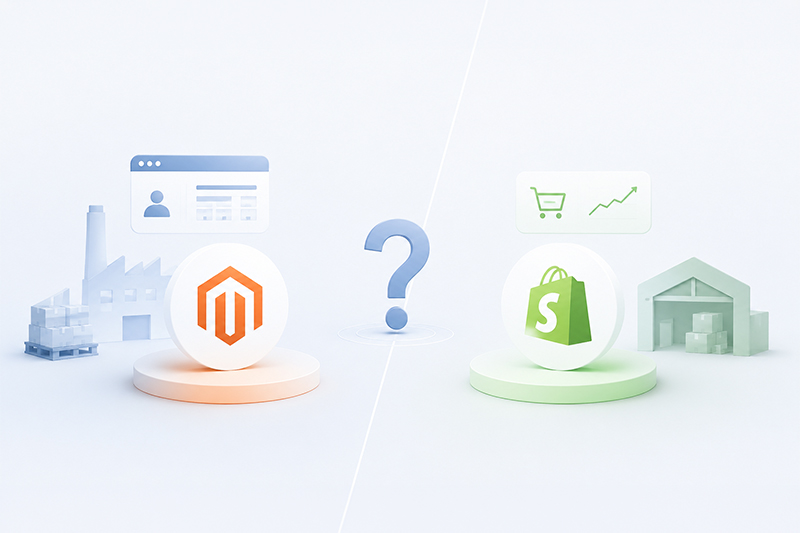
Is Magento B2B Better Than Shopify Plus for Manufacturers and Wholesale Businesses in 2026?
Which platform is better suited to the way your B2B business actually sells?
For manufacturers and wholesalers with complex commercial processes, Magento B2B for Online Shops can offer a particularly strong foundation because of its flexibility, extensibility and ability to accommodate sophisticated ecommerce and ERP requirements. However, Shopify Plus can be the better choice for businesses that prioritise rapid deployment, a managed SaaS environment and a comparatively straightforward B2B model. Here is how the two platforms compare.Magento B2B vs Shopify Plus: The Short Answer
If your business sells through complex customer structures, negotiated pricing, multiple buyer roles, purchase orders, approval workflows, ERP integrations and highly customised catalogues, Magento B2B for Online Shops is generally the stronger option. If your B2B operation is relatively straightforward, your team prioritises ease of management and speed to market, and you are comfortable working within Shopify's platform architecture, Shopify Plus may be the more practical choice. The distinction becomes clearer when the platforms are compared feature by feature.| B2B requirement | Magento B2B / Adobe Commerce | Shopify Plus |
| Company accounts | Strong | Strong |
| Multiple buyers and roles | Strong | Strong |
| Company hierarchies | Strong | Supported through company/location structures |
| Customer-specific catalogues | Strong | Strong |
| Customer-specific pricing | Strong | Strong |
| Negotiable quotes | Native in Adobe Commerce B2B | Often requires additional solution depending on workflow |
| Purchase orders | Native | Supported |
| Approval workflows | Strong native capability | Available, with some advanced workflows using Plus features/apps |
| Quick ordering | Native | Native |
| Reordering | Requisition lists | Quick order/lists and apps |
| ERP integration | Highly flexible | Strong APIs and integrations |
| B2B + B2C | Strong | Strong |
| Deep customisation | Very strong | Strong, but within SaaS architecture |
| Hosting responsibility | Depends on Magento deployment | Shopify managed |
| Control over architecture | High | More constrained |
| Best fit | Complex B2B operations | Fast, managed B2B commerce |
Company Accounts: How Do Magento and Shopify Handle Business Customers?
A B2B customer is rarely just one person. A manufacturer might sell to a company where the purchasing manager creates orders, a department manager approves them and the finance team handles payment. A wholesaler might have several branches, each with its own buyers and delivery addresses. This is where Magento B2B for Online Shops has a particularly strong proposition. Adobe Commerce B2B treats the company account as a central entity. Multiple buyers can belong to the same company account, with different roles and permissions. Company structures can also reflect divisions, subdivisions and users. This is much closer to the way many manufacturers and wholesalers actually operate. A company account can therefore become the foundation for:- Buyer management
- Roles and permissions
- Purchasing
- Quotes
- Company credit
- Purchase orders
- Approval processes
- Customer-specific catalogues
- Pricing
The difference
Both platforms can handle company-based selling. The more important distinction is what happens when the organisational structure becomes complicated. For a straightforward wholesale business, Shopify Plus may be entirely sufficient. For a manufacturer with several customer entities, complex approval structures and extensive custom business rules, Magento B2B for Online Shops provides greater scope for building the ecommerce environment around those requirements.Multi-User Organisations and Buyer Permissions
A successful B2B ecommerce platform must recognise that not every employee should have the same purchasing authority. Consider a distributor with:- 20 sales locations
- Multiple purchasing managers
- Regional managers
- Finance users
- Head-office administrators
Customer-Specific Pricing: Where B2B Commerce Gets Serious
B2B pricing is rarely as simple as: Product = €100. One customer may receive €90. Another may receive €85 because of annual volume. A distributor may have a negotiated contract price. A strategic customer may see a completely different product assortment. This is one of the areas where Magento B2B for Online Shops can be particularly useful. Adobe Commerce's Shared Catalog functionality allows merchants to create catalogues with custom pricing and assign them to specific companies. That means a business can control:- Which products a customer sees
- Which prices they see
- Which categories are available
- Which companies can access a catalogue
Where Magento has an advantage
The advantage becomes more apparent when customer pricing needs to interact with other systems and business rules. For example:ERP price list → Magento → customer account → customer-specific catalogue → checkout
If pricing is controlled by SAP Business One or another ERP, the ability to customise the data model and integration layer can become more important than the basic pricing feature itself. That is a major reason manufacturers and wholesalers should consider Magento B2B for Online Shops beyond the storefront.Shared Catalogues and Private Product Assortments
A manufacturer may not want every customer to see its complete product catalogue. A distributor might have access to one product range. A strategic reseller might have another. A regional customer might only be permitted to purchase products available in its market. Magento's Shared Catalog functionality is specifically designed for this type of B2B scenario. Custom catalogues can be assigned to specific companies, with product visibility and pricing controlled accordingly. Shopify Plus also supports direct catalogue assignment to companies and locations. This means both platforms can support private or customer-specific catalogues. The deciding factor should therefore be the complexity surrounding the catalogue. If your catalogue rules are relatively simple, Shopify Plus may work very well. If catalogue visibility is tightly connected to customer groups, ERP data, sales territories, contract conditions or complex product structures, Magento B2B for Online Shops offers more room for bespoke implementation.Quotes and Negotiation: Can Customers Negotiate Online?
For many B2B companies, the checkout price is not necessarily the final price. A customer might request:- A larger quantity
- A special discount
- Different delivery terms
- A project-specific price
- A combination of products
- A revised quotation
Why this matters
If your sales team still receives most quote requests by email, manually changes Excel files and then re-enters the agreed price into an ecommerce system, the ecommerce platform is not really digitising the commercial process. It is simply displaying products online. A well-designed Magento B2B for Online Shops implementation can connect the quotation process to the wider customer account and order workflow.Purchase Orders and Approval Workflows
Purchase orders are a standard part of B2B procurement. A buyer may create a PO, but someone else may need to approve it before the order can proceed. Adobe Commerce supports company purchase orders and approval rules. Companies can establish rules based on order values and user roles. For example, lower-value orders may be approved automatically while larger orders require one or more additional approvals. This is an important distinction between a B2B ecommerce website and a conventional online shop. The website is not simply processing payments. It is participating in the customer's procurement process. Shopify Plus also offers advanced B2B payment and order capabilities, and Shopify's 2026 updates include order-review rules using Shopify Functions. For companies with relatively straightforward purchasing, Shopify may be sufficient. For organisations where approval logic is deeply connected to company hierarchy and procurement policy, Magento B2B for Online Shops can provide a more flexible foundation for the required workflow.Quick Ordering and Reordering
B2B customers often know exactly what they want. They may not want to browse product categories for twenty minutes. They may simply have a list of SKUs and quantities. Magento's Quick Order feature allows buyers to create orders using product names or SKUs. Requisition Lists allow frequently purchased products to be saved for faster future orders. That can be particularly valuable for:- Spare parts
- Packaging
- Components
- Industrial products
- Wholesale stock
- Regular replenishment orders
ERP Integration: The Deciding Factor for Many Manufacturers
For a manufacturer or established wholesaler, the ecommerce platform rarely operates alone. The real technology stack may include:- ERP
- CRM
- PIM
- WMS
- Accounting
- Payment services
- Shipping systems
- EDI
- Customer service platforms
- Which system owns product data?
- Which system owns customer data?
- Where are prices calculated?
- Where is inventory controlled?
- Where are orders created?
- How are returns synchronised?
- What happens when synchronisation fails?
- Can customer-specific pricing be transferred?
- Can multiple companies be handled?
- Is stock available in real time?
Magento B2B for Online Shops and B2B + B2C Commerce
Many manufacturers and wholesalers no longer operate purely as B2B businesses. They may sell:- To distributors
- To retailers
- Directly to consumers
- Through marketplaces
- Through regional stores
- Catalogues
- Pricing
- Payment terms
- Checkout rules
- Account structures
- Ordering workflows
Customisation: How Much Control Does Your Business Need?
This is arguably the most important difference. Shopify Plus provides a managed SaaS environment. That means the merchant does not have to manage the underlying infrastructure in the same way as a self-hosted Magento implementation. That is a genuine advantage. Shopify Plus also offers APIs, apps, Shopify Functions and development tools for extending the platform. Shopify itself positions the platform around rapid deployment and API-based development. Magento takes a different approach. Magento B2B for Online Shops gives businesses much greater control over the underlying application, data model, integrations and custom business logic. That can be a major advantage for a manufacturer with unusual requirements. It can also mean more responsibility. A complex Magento implementation requires an experienced development and support partner. Poorly designed customisations can create maintenance problems later. So Magento's flexibility should not be viewed as “free flexibility”. It needs to be implemented properly.Total Cost of Ownership: Which Is More Affordable?
The cheapest platform to launch is not necessarily the cheapest platform to operate over five years. A proper B2B ecommerce TCO calculation should consider:- Platform fees
- Hosting
- Development
- Extensions
- Apps
- Integration
- Maintenance
- Security
- Upgrades
- Support
- Transaction fees
- Customisation
- Internal administration
Scalability: Which Platform Is Better for Growing Manufacturers?
Both platforms can scale. The more useful question is: what exactly is growing? If order volume increases, both platforms can support growth. But B2B complexity can grow much faster than order volume. A manufacturer might go from: 100 customers → 500 customers → 2,000 customers while simultaneously moving from: one price list → 20 price lists → customer-specific contracts and: one buyer per company → multiple departments and approval levels. That is where platform architecture becomes important. Magento B2B for Online Shops is particularly suited to organisations where growth means more complicated business rules, integrations and customer structures. Shopify Plus is attractive when growth means higher transaction volume, international expansion and a need to launch and operate efficiently within a managed platform.Which Platform Is Better for Manufacturers?
For manufacturers, the answer usually depends on the complexity of the sales model. Choose Magento when:- You have complex customer-specific pricing.
- Your ERP is central to your business.
- Customers have different catalogues.
- You require sophisticated quotation workflows.
- Your customers have complex approval structures.
- You need substantial customisation.
- You operate B2B and B2C with significantly different requirements.
- You need deep control over integrations.
- Your product data and commercial rules are highly specialised.
Choose Shopify Plus when:
- Your B2B model is relatively straightforward.
- Speed of deployment is a major priority.
- Your organisation prefers a managed SaaS platform.
- Your existing technology stack already works well with Shopify.
- You want to minimise infrastructure management.
- Your B2B and B2C experiences can share a relatively standard architecture.
Which Platform Is Better for Wholesalers?
Wholesale businesses should start with the buying process rather than the platform. If customers typically:- Log in
- Browse a customer-specific catalogue
- See negotiated prices
- Add products
- Reorder
- Pay under agreed terms
- Customer-specific contracts
- Multiple company structures
- Negotiable quotes
- Purchase approvals
- Complex ERP logic
- Multiple price rules
- Extensive product restrictions
What About Businesses That Should Choose Neither?
Magento and Shopify Plus are not automatically the right answer for every B2B business. Consider another platform if:- Your requirements are primarily procurement rather than ecommerce.
- You need a highly specialised industry platform.
- Your sales process is almost entirely offline.
- Your product catalogue is extremely small.
- Your ERP already provides an adequate B2B portal.
- Your requirements cannot justify the implementation cost of either platform.
Magento B2B vs Shopify Plus: Decision Matrix
| Business requirement | Magento B2B | Shopify Plus |
| Simple wholesale ecommerce | Excellent | Excellent |
| Complex company structures | Excellent | Very good |
| Customer-specific pricing | Excellent | Excellent |
| Private catalogues | Excellent | Excellent |
| Negotiated quotes | Excellent | Good, depending on implementation |
| Purchase orders | Excellent | Very good |
| Approval workflows | Excellent | Very good |
| Quick ordering | Excellent | Excellent |
| Reordering | Excellent | Excellent |
| Deep ERP integration | Excellent | Very good |
| Heavy customisation | Excellent | Good–Very good |
| Managed infrastructure | Depends on deployment | Excellent |
| Rapid deployment | Good | Excellent |
| B2B + B2C | Excellent | Excellent |
| Complex manufacturing workflows | Excellent | Very good |
| Straightforward wholesale | Excellent | Excellent |
| Architectural control | Excellent | More limited |
| Ease of platform management | Requires specialist support | Excellent |
The Real Question: Magento or Shopify?
The Magento vs Shopify Plus B2B decision should not be based on which platform has the longer feature list. Both platforms have matured considerably. Shopify has made B2B commerce more accessible, and its 2026 expansion means many B2B features are now available beyond Plus. Magento and Adobe Commerce continue to offer a deep B2B feature set covering company accounts, organisational structures, custom catalogues, quotes, purchase orders, approval rules, quick ordering and requisition lists. The real dividing line is complexity and control. If your business needs a highly controlled B2B commerce environment that can be shaped around complex commercial processes, Magento B2B for Online Shops is likely to be the more flexible foundation. If your requirements are relatively standard and your priority is a managed SaaS environment with fast implementation, Shopify Plus may be the more efficient option.Where Ingold Solutions Fits Into the Decision
Choosing the platform is only the first decision. The quality of the implementation can have just as much impact on the result. At Ingold Solutions, Magento B2B for Online Shops is offered as an in-house-developed solution for business customers, with options for a standalone B2B shop or a B2C+B2B hybrid environment. The current offering includes features designed around company accounts, multiple buyers, customer-specific pricing and B2B purchasing requirements. For businesses already using SAP Business One, Magento can also become part of a broader ERP and ecommerce architecture rather than operating as an isolated storefront. That distinction matters. The objective of B2B ecommerce is not simply to put a product catalogue online. It is to remove friction between your customer, sales team, warehouse, finance department and ERP system. If you are comparing Magento B2B for Online Shops with Shopify Plus and want to understand which architecture makes sense for your business, you can contact Ingold Solutions GmbH to discuss your requirements and implementation options.Final Verdict: Which Should You Choose in 2026?
There is no universal winner in the Magento B2B vs Shopify Plus B2B debate. For a manufacturer or wholesaler with straightforward requirements, Shopify Plus can provide an efficient, scalable and well-managed route into B2B ecommerce. For a business where ecommerce must accommodate complex company structures, customer-specific pricing, private catalogues, negotiated quotes, purchase orders, approval workflows, ERP integration and highly specific commercial rules, Magento B2B for Online Shops offers a compelling level of control. The best platform is therefore the one that matches the complexity of your business today and the direction in which it is likely to grow. If your B2B operation is becoming more complicated every year, choosing a platform solely because it is easy to launch may create limitations later. Conversely, if your requirements are straightforward, investing in unnecessary complexity can be equally counterproductive. Choose Magento when control, flexibility and complex B2B processes are central to your business. Choose Shopify Plus when speed, managed infrastructure and a streamlined B2B model are the bigger priorities. Choose another platform when neither architecture genuinely fits your commercial process. The right decision is not about choosing the platform with the most features. It is about choosing the platform that makes your customers' buying process—and your team's operations—simpler.Frequency Ask Question
For manufacturers with complex pricing, customer structures, ERP integrations, quotations and approval workflows, Magento can be the stronger option because it provides extensive control and customisation. Shopify Plus can be an excellent choice for manufacturers with simpler B2B requirements and a strong preference for managed SaaS.
It depends on the wholesale model. Shopify B2B is increasingly capable and now includes native companies, catalogues, payment terms, volume pricing and other features across multiple plans. Magento becomes particularly attractive when wholesale operations require deeper customisation, complex pricing, ERP integration or advanced procurement workflows.
Yes. Adobe Commerce B2B Shared Catalogues can provide custom pricing and product availability for specific companies.
Yes. Shopify Plus supports unlimited B2B catalogues and direct assignment of catalogues to companies and company locations.
Both can be integrated with ERP systems, but Magento’s architecture provides extensive flexibility for custom integrations and business-specific data flows. The important consideration is not the platform name alone but how products, customers, prices, inventory, orders and payments will be synchronised.
Yes. Adobe Commerce B2B is designed to support B2B and B2C models within the same commerce environment.
There is no universal answer. Shopify Plus has a recurring platform fee, while Magento costs depend on hosting, implementation, extensions, development and support. A proper five-year TCO comparison is more useful than comparing licence prices alone.